Beyond Prompts: How Context Engineering is Revolutionizing AI Agent Development
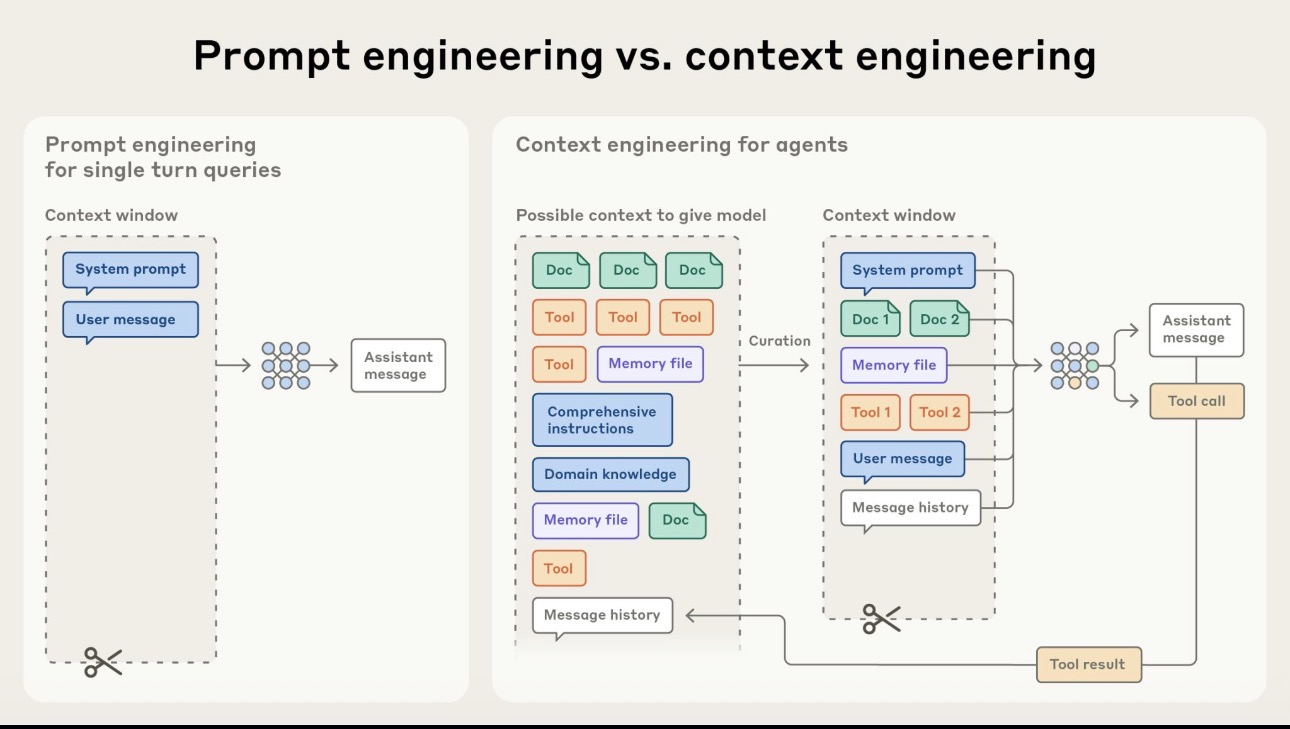
In the rapidly evolving landscape of AI development, a profound shift is taking place that promises to fundamentally change how we build intelligent systems. At GIS Analytics, we've been closely monitoring the emergence of context engineering as a critical discipline that moves beyond traditional prompt engineering to address the complex challenges of building effective AI agents.
The Context Engineering Revolution
While prompt engineering has dominated conversations around large language model (LLM) implementation, Anthropic's recent research reveals a more nuanced reality: in agentic settings—where AI systems must act over multiple steps, maintain contextual awareness, and leverage tools—the primary challenge isn't crafting perfect prompts. Instead, it's about intelligently managing what information enters the model's finite attention span.
Context engineering recognizes that all tokens fed into a model—system instructions, documents, memory records, tool specifications, and conversation history—compete for limited cognitive resources. As these tokens accumulate, LLMs suffer from what Anthropic terms "context rot"—a degradation in the model's ability to reliably retrieve and apply information from earlier in its context window.
Strategic Approaches to Context Management
The Goldilocks Principle
Effective context engineering requires finding the optimal balance in system prompts: neither over-specified and brittle nor vague and under-constraining. At GIS Analytics, our AI development team has embraced this principle, creating clearly delineated prompt structures that separate background information, instructions, tool guidance, and output specifications.
Resource Optimization Techniques
For complex, long-horizon tasks that inevitably exceed a model's context budget, several techniques have proven invaluable:
- Compaction: Summarizing prior interactions into compressed representations
- Structured note-taking: Strategically offloading memory outside the immediate context window
- Multi-agent decomposition: Delegating specialized tasks to sub-agents whose outputs are distilled for a coordinator agent
These approaches mirror human cognition, allowing AI systems to maintain performance without drowning in an overwhelming sea of information.
Implications for Enterprise AI Development
At GIS Analytics, we're implementing these context engineering principles across our AI/ML projects with remarkable results. By treating context as a scarce resource and continuously refining streaming context into high-signal subsets, we've created more reliable, efficient AI systems that maintain coherence across complex workflows.
The hybrid approach—pre-loading essential static context while allowing dynamic, just-in-time data fetching—has proven particularly effective for knowledge-intensive applications leveraging our advanced knowledge graph technologies.
Tool Design Considerations
Another critical insight from context engineering involves tool design. For AI agents to function effectively, tools must return token-efficient results with clear delineations between functions. Minimizing overlap and ambiguity prevents wasted context and improves decision-making around tool selection—a principle we've incorporated into our latest AI-powered analytics platforms.
The Future of Context Engineering
As we continue advancing our AI capabilities at GIS Analytics, context engineering will remain a cornerstone of our development philosophy. The ultimate goal is elegantly simple yet profoundly powerful: at every inference step, provide the model with precisely the right context to maximize desired behavior—no more, no less.
This approach reframes AI development as a resource optimization problem: selecting the minimum tokens with maximum signal. For enterprises deploying complex AI systems, mastering context engineering will increasingly separate truly effective implementations from those that struggle with reliability and performance at scale.
As we partner with clients across industries to build next-generation AI solutions, these principles will continue guiding our work in creating systems that combine sophisticated capabilities with robust, predictable performance.