GIS Analytics Secures UCL Funding to Develop Graph-Powered AI Governance for SMEs
 ×
×
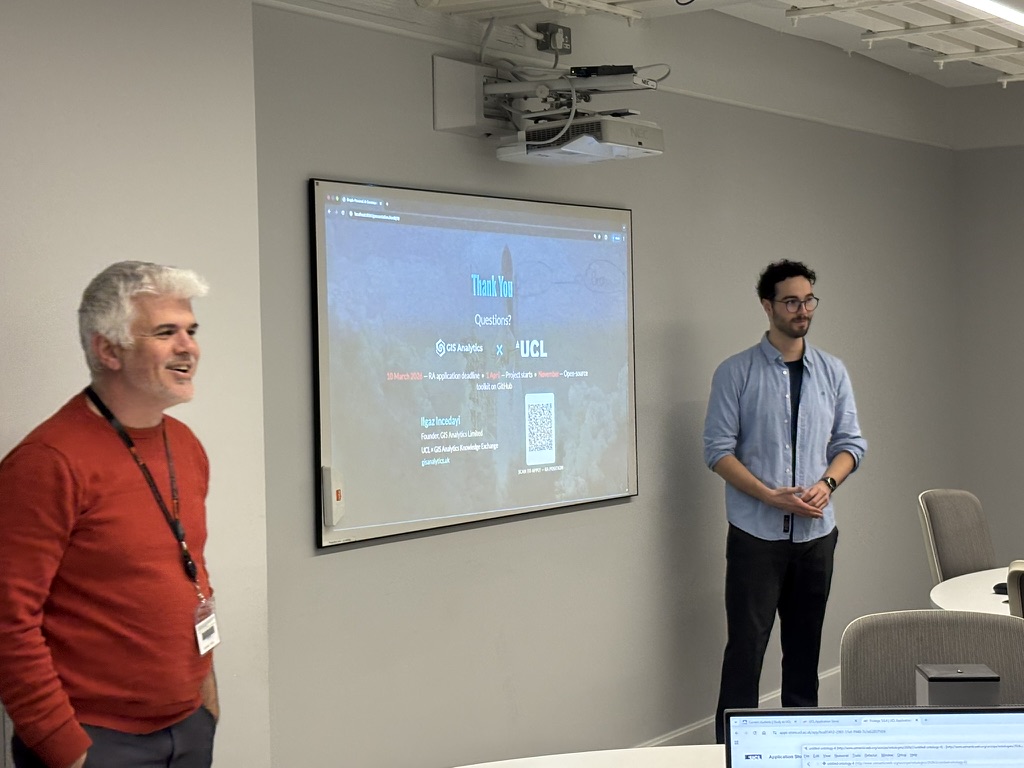
Prof. Antonis Bikakis (UCL) and Ilgaz Incedayi (GIS Analytics) presenting the Knowledge Exchange project to students at UCL, March 2026.
GIS Analytics has secured funding through UCL's Innovation & Enterprise Impact Acceleration Account (IAA) to develop a framework for transparent, trustworthy AI decision-making in small and medium-sized enterprises. The award followed a competitive review by two independent assessors and positions GIS Analytics as industry partner on a six-month Knowledge Exchange project running from April to November 2026 — bringing together academic expertise in graph databases and AI explainability with GIS Analytics' experience applying AI systems in real-world business contexts.
The Problem We're Solving
Artificial intelligence is becoming central to how businesses make decisions: allocating resources, assessing risk, routing customers, flagging anomalies. But for many organisations — particularly SMEs — the decision-making logic of AI systems remains opaque. A model that produces a recommendation without explanation is difficult to audit, challenge, or trust.
The EU AI Act, which introduces mandatory transparency requirements for certain AI applications, makes this practical problem a compliance one. SMEs deploying AI now face obligations around explainability that they frequently lack the tools to meet. This project addresses that gap directly.
The Approach: Graph Databases as an Explainability Layer
Graph databases represent information as networks of relationships rather than rows and columns. This structure makes them particularly well-suited to the problem of AI explainability: they can capture not just what a system decided, but why — the chain of relationships, data points, and inference steps that led to a particular output.
Working with Prof. Antonis Bikakis from UCL's Department of Information Studies, whose research focuses on knowledge representation and AI explainability, GIS Analytics is developing a framework that embeds transparency into the architecture of AI decision pipelines. Rather than treating explainability as a reporting afterthought, the framework makes it a structural property of the system itself.
GIS Analytics contributes the operational context: the kinds of AI systems SMEs actually deploy, the business decisions they inform, and the practical constraints under which governance must operate. This is knowledge exchange, not pure research — established academic expertise applied to live business problems.
The Team
The project is led by Prof. Antonis Bikakis (Principal Investigator, UCL Department of Information Studies), with Ilgaz Incedayi (Founder & Director, GIS Analytics) as industry partner. Bridging both environments is Xingyuan Feng, a PhD Research Assistant at UCL who works across the academic and industry dimensions of the project — ensuring the research remains grounded in real operational requirements throughout.
The collaboration was facilitated through UCL's Knowledge Exchange programme by Karen Stephanyan.
What the Project Will Deliver
By November 2026, the project will produce three concrete outputs:
- An AI governance system — a working implementation of the graph-based framework applied to a real business context, demonstrating how AI decision-making can be made transparent and auditable within SME constraints.
- An open-source toolkit on GitHub — published and freely accessible, so that other organisations can adopt and adapt the framework without depending on proprietary solutions or specialist consultancy.
- Best practices guidance for SMEs — practical, operational guidance for navigating AI transparency requirements under the EU AI Act, written for organisations without dedicated AI governance teams.
The decision to make the toolkit open-source reflects both UCL's commitment to knowledge transfer and GIS Analytics' belief that AI governance should be accessible to organisations of all sizes.
Why This Matters
The IAA programme supports projects that connect UCL research to real-world business problems. This project is a direct expression of that model: rigorous academic work on graph-based explainability, applied to a challenge that matters now for businesses deploying AI.
For GIS Analytics, the Knowledge Exchange project reflects a broader commitment to responsible AI deployment. We build AI systems that inform consequential decisions. Understanding how to make those decisions transparent — and building the open-source tools to do so — is not a compliance exercise. It is a prerequisite for building AI that organisations can genuinely trust.
The project begins in April 2026. We will share updates on progress and early findings as the work develops. Organisations with an interest in AI governance, EU AI Act compliance, or graph-based approaches to explainability are welcome to get in touch.